Strategy is one of the most dangerous concepts in business. Why dangerous? Because while most managers agree that it is terrifically important, once you start paying attention to how the word is used you will soon be wondering whether it means anything at all.
Joan Magretta
Joan Magretta made the comment about strategy being dangerous in her 2012 book Understanding Michael Porter. At the time it really resonated with me. And it still does!
My experience as a strategy practitioner, researcher, teacher and consultant has convinced me that, rather than providing focused direction, strategy has become overly complicated, fragmented, and confusing. Strategic Plans have become a laundry list of unrelated activities. Everything is strategic………..strategic thinking, strategic execution, strategic courage, even strategic strategies! Strategy has lost its way.
Many firms don’t have an explicit, shared logic to their Business Strategy, one that guides coherent and integrated choices focused on creating Customer Value. Without this logic, the direction of the firm is vague, there is confusion over what really matters, there is no clear framework for resource allocation other than extrapolation of history, there are strategies for everything, and people end up trying to do everything. Silos of power and self-interest develop, and choices are made for the wrong reasons. Even worse, a crazy notion has been popping up since the early 2000s to explain strategy failures – strategy and execution are different, firms can have a good strategy that fails because of poor execution.
I argue that these problems have their roots largely in the ‘institution’ of Strategic Planning.
Strategic Planning started in US corporations in the 1950s and spread rapidly. By the 1970s, it was commonly thought of as ‘the one best way’ to make strategy. Today it has become institutionalised in the corporate, social enterprise and government sectors. An ‘Annual Strategic Plan’ has even become a statutory requirement in some organizations.
However, strategic planning has been increasingly criticised over the last 30 years. In 1994 Brian Quinn wrote in Strategic Planning R.I.P.
A good deal of corporate planning……..is like a ritual rain dance. It has no effect on the weather that follows, but those who engage in it think it does…..Moreover, much of the advice related to corporate planning is directed at improving the dancing, not the weather.
What Quinn was getting at was that strategic planning was more focused on planning (dancing) than strategy (rain). Henry Mintzberg was another early critic with his 1994 book The Rise and Fall of Strategic Planning. Mintzberg described strategic planning as an ‘oxymoron’, arguing that strategy cannot be planned because planning is primarily about analysis while strategy is primarily about synthesis.
Fast forward to 2023 …… The flow of posts, articles and books about the problems with strategic planning has continued. The big consultancy firms have proposed numerous recipes to address these problems, but these recipes have generally been based in strategic planning itself. They’ve been tweaks to the process, rather than reforms.
Today many senior management teams and their consultants still work for months on detailed analyses of macroeconomic, industry, competitors, and firm performance data. They use a myriad of strategy tools (sometimes regardless of their relevance), bounce around between fluffy Vision, Mission, and Values statements, hold strategy workshops and other planning meetings with participants from the board down to the shopfloor……they expend a great deal of time and effort, and produce volumes of data.
All this data goes into Strategic Planning’s ‘black box’. To the extent that there is an algorithm it is usually extrapolation of history overlaid with corporate politics and decision biases. Then, almost by magic, out of the box pops 3-to-5-year predictions and a set of firm specific objectives along with a ‘laundry list’ of fragmented threads of activity, typically called strategies, intended to achieve those objectives. And a set of KPIs that make the laundry list look like a short note and frustrate employees because everything is important.
Not surprisingly, many practitioners have come to the position that Strategic Planning is no longer the ‘one best way to make strategy’. If you would like to see a good summary of this position look at Roger Martin’s You Tube Video A Plan Is Not a Strategy. It reached 1.2 mill views just 4 months after it was posted in mid 2022. It obviously resonated with practitioners.
But the problem is not just overemphasis on analysis and planning. It’s also a lack of focus on Customers and Customer Value. In 1954 Peter Drucker argued:
There is only one valid definition of business purpose, to create a customer. It is the customer who determines what a business is. For it is the customer, and he alone, who through being willing to pay for a good or for a service, converts economic resources into wealth, things into goods. What the business thinks it produces is not of first importance – especially not to the future of the business and to its success. What the customer thinks he is buying, what he considers ‘value’, is decisive – it will determine what a business is, what it produces and whether it will prosper.
Drucker’s point is still relevant today. While I recognize that analysis and planning have a contribution to make, I argue that Business Strategy must be grounded in a Customer view and that its focus should be on developing new and better ways to contemporaneously create Customer and Organization Value. Rather than extrapolating what a firm is currently doing, strategy should be about imagining what it might do and learning how to do it. The concepts and tools of Design and Innovation should take precedence over analysis and planning. Strategy should be about developing insight into what really matters for Customer and Organization Value Creation and making choices – what to do, and just as importantly, what not to do – based on that insight.
So, if you’re disappointed with your annual strategic planning ritual, if your strategy has lost focus or has descended into a laundry list of fragmented and confusing activities, if performance is mediocre and people are frustrated because they trying to do everything, then maybe it’s time to try something different.
Over the last twenty years, through my PhD research (The Role of the Board in Firm Strategy: A Strategy as Practice View), consulting, and teaching, I have developed an alternative to traditional strategic planning, a strategy framework that I call Strategy Conversations in Practice (SCIP). This framework represents a synthesis of ideas from Strategy as Practice, as Design and as Innovation, aimed at developing better Business Strategy by continuously reconfiguring the value creation choices an organization makes.
SCIP relies on three building blocks – understanding strategy in terms of a pattern or system of value creation choices, using the Business Model View to describe this pattern or system, and framing the process of strategy as a learning loop of four distinct but interconnected, iterative and reflective Strategy Conversations with the Business Model View at its core, as a touchstone for each Conversation and the collective output of all four Conversations.
Strategy as a Pattern or System of Value Creation Choices
In Strategy Conversations in Practice, I define Business Strategy as:
……. the system or pattern realized in the choices – what to do, what not to do – an organization makes in creating value for its Customers, for itself and for its stakeholders.
There are several important implications of framing strategy in this way. First, it grounds strategy in a Customer view, and recognizes that creating Customer Value is the end goal of strategy while building competitive advantage (where relevant) is the means to that end. In turn, creating Customer Value enables value creation for the organization itself and for its stakeholders. Second, strategy is defined not by plans but rather by an organization’s actions (whether deliberate or emergent), by what it chooses to do and just as importantly, by what it chooses not to do.
Third, framing strategy in this way both encourages and enables social enterprises and government owned corporations and agencies to define their end goal in terms of value creation for a defined group of beneficiaries and to focus their choices accordingly. Contrast this with Strategic Planning in these sectors, whereby the default position is usually an attempt to be all things to all stakeholders, which is a recipe for mediocrity at best.
Business Model View
The concept of strategy as a system or pattern of value creation choices lends itself well to a coherent and integrated description using the Business Model View. While there are multiple ways to describe a Business Model, I prefer a simple but not simplistic approach that involves four major components.
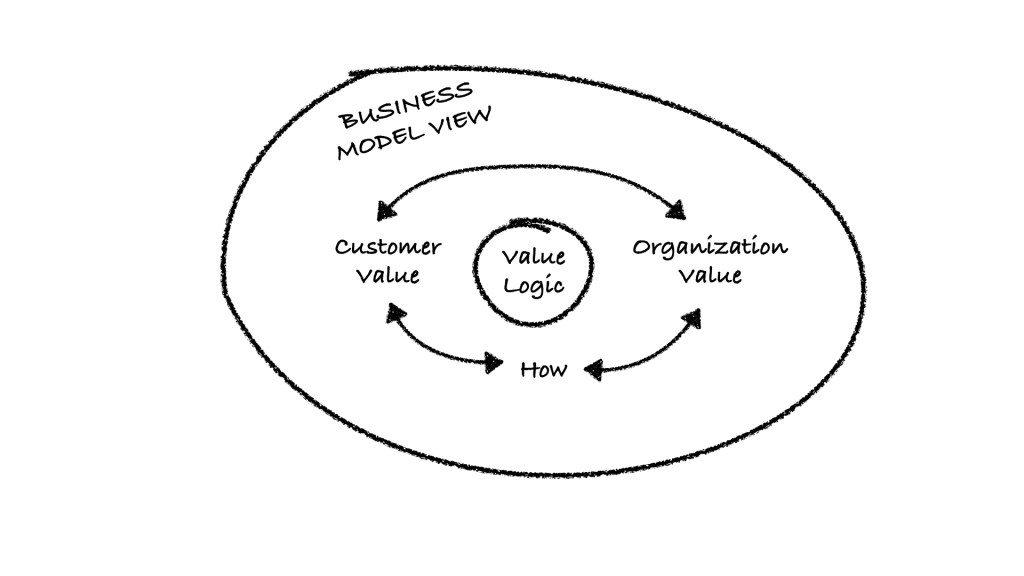
In this Business Model View, ‘Customer Value’ focuses on a firm’s choices about who its Primary Customers (or Beneficiaries) are and the Value Proposition it offers to those Customers. ‘Organization Value’ focuses on prioritizing and integrating choices about who the firm’s stakeholders are and the Economic, Social and Environmental Value it aims to create for those stakeholders. ‘How’ focuses on the firm’s choices regarding capabilities and resources to contemporaneously create this Customer and Organization Value. These three components are interdependent, you cannot make choices about one without reference to the other.
The Value Logic is the firm’s theory of value creation. It describes the thinking that binds the choices about Customer Value, Organization Value, and How together to form the Business Model. An effective Business Model, one that meets Customer and Organization Value Creation expectations, is both coherent (logical, consistent and concise) and integrated (fit together, mutually reinforcing).
In SCIP, a firm’s competitive advantage is not derived from isolated choices but rather from the coherence and integration designed into its Business Model relative to its competitors. Competitive advantage is not the end goal of strategy but rather the means to better Customer and Organization Value Creation as the end goal.
Strategy Conversations
Strategy Conversations in Practice proceed through a learning loop of four distinct but interconnected, iterative, and reflective ‘Conversations’ with the Business Model View at the core of the loop, as a touchstone for each Conversation and the collective output of all four Conversations.
Each Conversation has a different focus, and each involves overlapping episodes of dialogue, either formal or informal, one on one or in groups, short or long term in orientation, inside and outside the organization, in a timeframe determined by context and performance rather than an annual budgeting/planning cycle. The aim of these Conversations is to continuously reconfigure the value creation choices a firm makes.
Making Sense Strategy Conversations are primarily about synthesis, understanding what the unique strategy opportunity, problem or question is for a firm (not a laundry list), and on creatively developing ‘Alternative Futures’ in which this opportunity, problem or question is resolved.
Designing Strategy Conversations translate the ‘Alternative Futures’ into coherent and integrated Business Model prototypes and test each prototype until choices can be made between them. These Conversations rely on concepts and tools from Strategy as Design and Strategy as Innovation.

Making Things Happen Strategy Conversations focus on moving from the existing Business Model towards the chosen Business Model prototype(s). More specifically they involve integrating a portfolio of Business Model Innovation ideas, framed and managed as Strategy Projects, with the existing Business Model, while at the same time maintaining value creation by that existing Model.
Revising Strategy Conversations continuously track Customer and Organizational Value Creation relative to expectations and progress with the Strategy Projects initiated in the Making Things Happen Conversations. The key questions at this stage are: does the firm maintain the course, does it tweak or refresh the Strategy Projects portfolio, or does it move into a new Making Sense Conversation and change the strategy?
So, to come back to my earlier call to action………if you’re disappointed with your annual strategic planning ritual, if your strategy has lost focus or has descended into a laundry list of fragmented and confusing activities, if performance is mediocre and people are frustrated because they’re trying to do everything, then maybe it’s time to try something different.
I plan to publish a series of Posts on SCIP that will hopefully assist practitioners to put the framework into action in their own firms. The next Post – The Strategy Conversations Framework: It’s About Better Strategy – will provide a more in-depth discussion of the Conversations process and the thinking that underpins it.
Summary: The core proposition of SCIP is that a coherent and integrated pattern or system of choices – what to do, what not to do – grounded in Customer and Organization Value Creation, and continuously reconfigured through a learning loop of four distinct but interconnected, iterative, and reflective Strategy Conversations – Making Sense, Designing, Making Things Happen and Revising – leads to better Business Strategy and better firm results.


 Strategy Conversations In Practice
Leave a comment