Our big, airy, audacious goal as a business is to ensure that every single human on Earth has access to clean water and a toilet by the year 2050.
Danny Alexander Co-founder & Chief of Product and Purpose at WGAC
I spent most of my working career in the ‘multi-national corporates’ sector. That’s where I learned that Strategic Planning had become an institutionalized ritual in many firms, a rain dance rather than a rain maker. It wasn’t until I got into strategy teaching and consulting that I had the opportunity to meet a range of executives from Social Enterprises, both in government and non-government sectors. I also got to review quite a few Strategic Plans from firms in those sectors and realized that all the same strategy problems were in place but to a greater extent — ‘laundry lists’ of fragmented activities, complexity, and a lack of clarity were pervasive, people were trying to do everything!
In the early days, when I tried to introduce the Business Model View, I would get pushback from Social Enterprises, usually with comments like ‘that’s a corporate model, it doesn’t apply here’. That perspective, and the growing number of people from Social Enterprises in our Strategy in Action courses, influenced me to begin using Social Enterprises as case studies and to work with participants to reverse design the Business Models for each case.
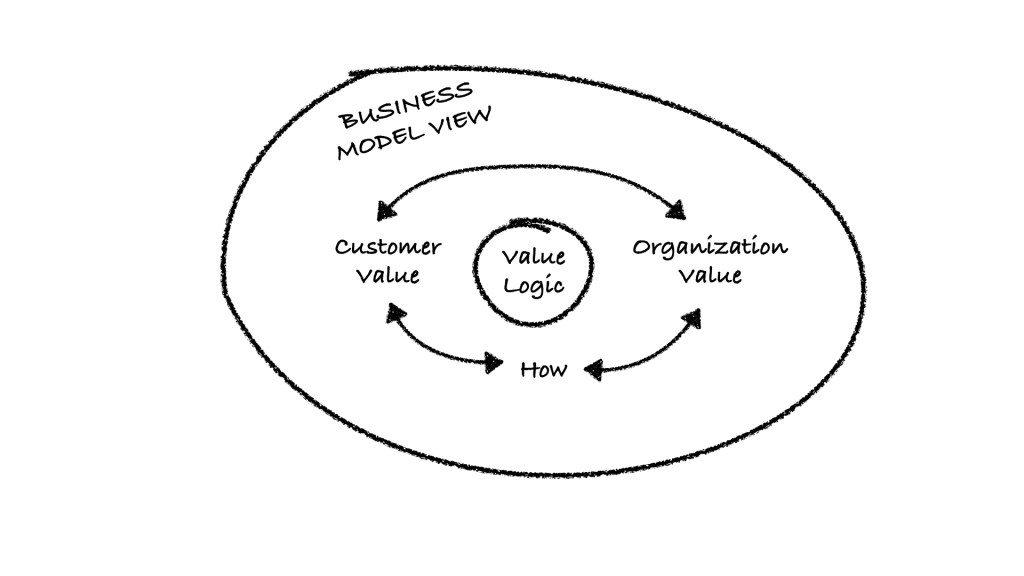
The process involved articulating the Who, What, Why and How of Customer and Organization Value creation for each case, configuring these components into a cause-and-effect Business Model, and then looking for innovative ways to improve the performance of that model.
After each case there would be a reflection session focused on the application to participants’ own organizations. Two common observations from those who worked in Social Enterprises were:
– We need to think more about the notion of Customers, who they are. And we need to better understand what ‘value’ actually means to them rather than what we think it should be. We also need to recognize that not everyone is our Customer.
– We’re trying to do too much, to help everyone. We must focus more on doing ‘what really matters’ for value creation. And we must consciously choose what not to do or we’ll burn out.
As an example of this process, I’ve reverse designed the Business Model for Who Gives A Crap (WGAC) in this Post. I first learned about this business during the Covid toilet paper wars in Australian supermarkets and have followed it ever since.
WGAC is an Australian subscription (primarily) toilet paper business that was founded in 2012 based on two core principles:
– To create an environmentally friendly toilet paper product that is also “amazing” to use.
– To donate half its profits to improving sanitation and water safety for people in need in developing countries. In the words of co-founder Danny Alexander:
Besides sustainability………the other big problem Who Gives A Crap wants to help solve is the fact that billions of people worldwide don’t have access to adequate water and sanitation facilities.
By the way, I doubt that airy in the introductory quote is a typo. It’s just an example of WGAC’s irreverent sense of humour.
WGAC is a business on a roll (yes, I know, it’s a crappy pun). In 2013 WGAC donated $A2.5K to its sanitation and water safety partners in developing countries while, at the time of writing this Post, the cumulative donation over ten years has been over $A13 million!! That’s a big chunk of money for a small business. And its environmental credentials are first class. In April 2021 the Natural Resources Defense Council in the U.S. reported on the sustainability of 26 toilet paper brands and named WGAC as the number 1 brand in the market.
So, what does WGAC’s business model look like? My take (reverse design) on each of the key components is:
Primary Customers: Consumers who are proud to be irreverent, who see the fun in putting their toilet paper on display and who are prepared to pay a premium for a product that supports social and environmental good. In other words, consumers ‘who give a crap’.
Customer Value Proposition: Toilet paper that is guaranteed to make you feel good or your money back — it’s environmentally friendly and at the same time, soft and comfy, with colorful and quirky packaging, an irreverent sense of humour, reliably supplied direct to the home and most importantly, it builds toilets and improves water safety for people in need.
When I talk about a Customer Value Proposition in the context of a Business Model, I always recommend that it be an internal perspective rather than advertising speak. Why? Because everyone in the business needs to clearly understand exactly what the Value Proposition means and what they need to do, in their own areas of responsibility, to deliver it. Contrast my version of WGAC’s Customer Value Proposition with the one on the Shop page of their website directed at consumers — toilet paper that’s “Good for your bum. Great for the world”. That’s advertising speak!
Value Logic: WGAC’s Value Logic is Product Leadership (see the Post An Unbalanced Value Logic Is The Key To Better Business Strategy). WGAC offers a unique toilet paper experience to a niche consumer group.
Organization Value: Economic Value in WGAC involves creating a financial surplus that allows the business to reinvest in revenue growth and to make meaningful contributions to its sanitation and water safety partners. Social and Environmental Value is created selling sustainable products and especially by building toilets and water safety infrastructure for vulnerable communities in developing countries.
How: WGAC’s key capabilities and resources focus mainly on reducing what its founders call the ‘tree to toilet pipeline’. There are three key aspects. First, WGAC’s sustainable supply practices include using high quality recycled paper in the signature product and bamboo in the premium product; pursuing low carbon emissions throughout the supply chain and low energy/low water use manufacturing processes; using recycled materials and elimination of single use plastic from all packaging. Second, WGAC’s irreverent and fun approach to marketing enables the business and brand to stand out in a mundane market. Third, WGAC’s relationships and results with proven sanitation and water safety partners in developing countries builds credibility and goodwill and drives revenue from current and new Customers.
The Business Model View presented below configures WGAC’s ‘excel’ capabilities in a concise cause-and-effect perspective. Several points are worth noting.
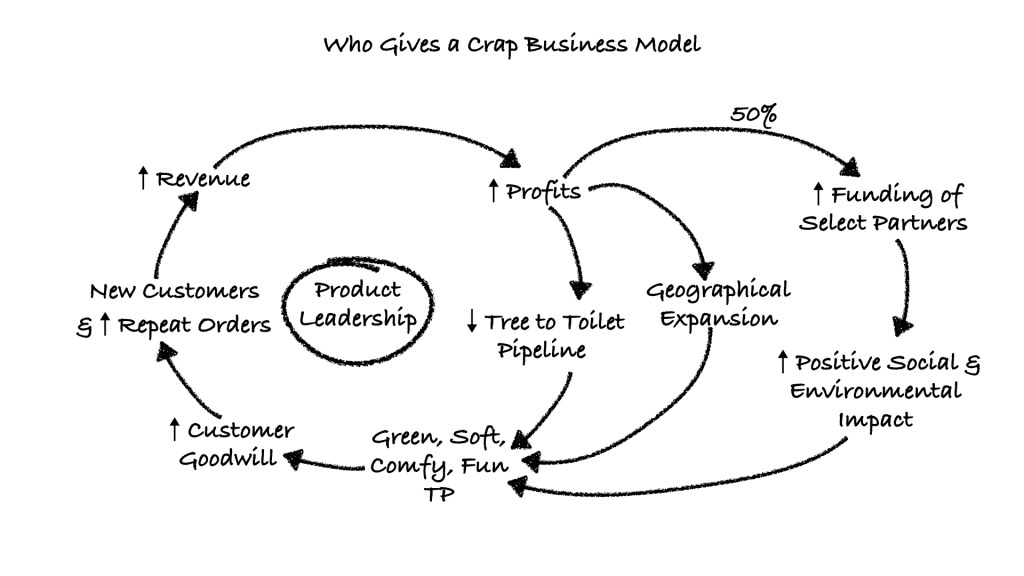
First, some people like to think about Social Enterprises as two-sided platforms. One side raises revenue for the other side to provide products or services that create ‘impact’ for the organization’s Beneficiaries. But, a common problem is that the two sides of the platform get out of balance. The ‘impact’ side gets most of the attention from management and employees because they’re more emotionally invested in it. After all, that’s why the organization exists. The ‘revenue’ side can’t keep up. ‘Mission creep’ exacerbates the imbalance and staff on both sides get frustrated and burn out.
WGAC integrates both sides of the platform into its Business Model. WGAC can do this because it has deliberately chosen what to do and what not to do. Rather than be involved in building sanitation and water safety infrastructure, WGAC believes that it maximizes social and environmental impact by focusing on generating financial capital and then allocating it to partners in developing countries to do the work.
Second, while WGAC’s dominant Value Logic is Product Leadership, there is a secondary focus on Operations Leadership, one that is manifest in sustainable sourcing, manufacturing and logistics practices with a simultaneous focus on cost control.
Third, WGAC must ensure that it meets threshold or table stakes standards in Customer and Organization Value expectations in areas such as website access and ease of use, inventory management and order fulfilment, managing cash flow to name just a few. One aspect where WGAC has probably been below table stakes standards is convenient access to product. Toilet paper is stocked in every supermarket in the country. WGAC products are only now starting to appear in the major chains, but this will need to be a strongerfocus in the future.
So, to finish — my purpose in presenting the WGAC story is to demonstrate that the Business Model View can be usefully applied to Social Enterprises. Its major advantage is the clarity it brings to Business Strategy by focusing on four components — Customer Value, Organization Value, How, and Value Logic — as well as on how they’re configured into a holistic system that identifies where to excel, where to meet table stakes and where not to bother.
Contrast this approach with a Five Year Strategic Plan that I recently reviewed from a well-known Australian Social Enterprise. It was 27 pages long, started with the usual Introductory comments and then went on to outline eight Strategic Priorities; five Themes (different to the Priorities) and Insights from each Theme; six Strategic Principles to guide Strategy Development and decision making; Vision, Belief, Purpose and Ambition statements; five Aims and four Commitments; a page on each of the eight Strategic Priorities that outlined Context, Vision and Strategic Objectives; and one final page on Implementation.
Jargon rich, word dense…..I struggled to see what really matters for Value Creation in this organization? That’s why I prefer to use the Business Model View in Strategy Conversations in Practice.
Summary: The Business Model View at the core of Strategy Conversations in Practice can be successfully applied to Social Enterprises such as Who Gives A Crap. Its major advantage is the clarity it brings to Business Strategy by focusing on four components — Customer Value, Organization Value, How, and Value Logic — as well as on the way they’re configured into a holistic system that identifies where to excel, where to meet table stakes and where not to bother. It cuts through the complex, fragmented and confusing ‘laundry lists’ in so many Strategic Plans, and helps to better identify what really matters to Value Creation, regardless of how it is measured.

 Strategy Conversations In Practice
Leave a comment