Use the Business Model View to Design a Coherent and Integrated Capabilities + Resources System
Different customers buy different kinds of value. You can’t hope to be the best in all dimensions, so you choose your customers and narrow your value focus…………… provide the best offering in the marketplace by excelling in a specific dimension of value……………maintain threshold standards in other dimensions of value….
Michael Treacy and Fred Wiersema in The Discipline of Market Leaders
In previous Posts I’ve covered the Who, What and Why of Customer Value (Being Customer Centric Is Not Strategy and Doing Everything Is Not Strategy), and Organization Value (Organization Value — Economic, Social, Environmental) in the context of a firm’s Business Model View and its underlying Value Logic. In this Post I cover How to create Customer and Organization Value simultaneously by focusing on the system of Capabilities + Resources that needs to be in place.
In using the Strategy Conversations In Practice framework in an existing organization the first step is to reverse design the existing Business Model. While this is an iterative process it starts with understanding the Primary Customers, their Job to be Done, the Value created for those Customers (specified in terms of Excel and Table Stakes Dimensions), the underlying Value Logic and the Organization Value created as a result. The process goes on to understand How the firm currently creates value for those Customers, for itself and for its stakeholders.
In this Post I will first discuss the ‘How’ of Value Creation as a stand-alone component and then discuss its interdependencies with Customer and Organization Value.
Capabilities + Resources System = How
There are multiple ways to conceive of ‘How’ in the Business Model View, each of which has merit. I prefer to keep it simple by thinking about ‘How’ in terms of a system of coherent and integrated Capabilities and Resources.
When I ask practitioners about their organization’s Capabilities and Resources, they often answer in terms of its structure and functions. But Capabilities and Resources are much more than that. Capabilities are cross-functional business processes or activities that enable value creation. For example, a logistics capability in a consumer products business might integrate functions such as order processing, invoicing, inventory control, distribution, customer follow up and returns management with the aim being to deliver low total cost to its Customers and cost efficiencies to itself.
Resources enable capabilities to be exercised and improved. Resources might be physical (plant, equipment, infrastructure, land), intellectual (technologies, brands, information systems), people (knowledge, skills, experience, relationships) and organizational (management systems or routines, culture, alliances, networks, reputation).
It’s the coherence and integration of Capabilities and Resources in the context of a firm’s Business Model that enable it to create value, not only for Customers but also for the organization itself and its stakeholders.
The Customer Value Proposition Determines the Capabilities + Resources System
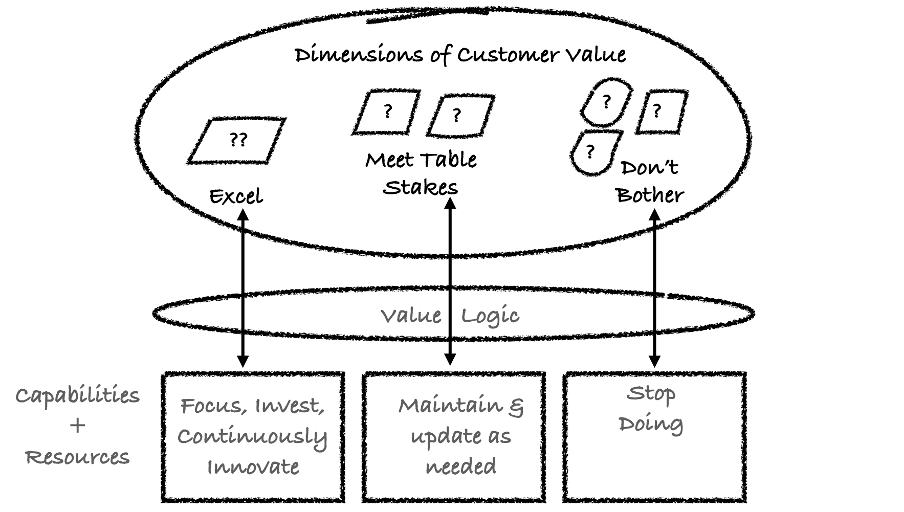
In SCIP, when a firm chooses its Primary Customers and the Value Proposition it offers to those Customers it automatically determines it’s dominant, albeit generic ‘Value Logic’, which in turn broadly informs choices on Organization Value and on the generic Capabilities + Resources system that must be in place.
The relationship between generic ‘Excel’ dimensions of Customer and Organization Value and ‘Excel’ Capabilities and Resources is summarized in the table below.
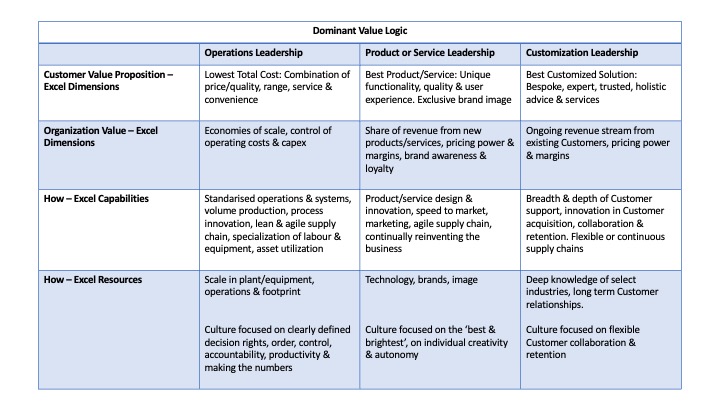
More specifically:
‘Excel’ Capabilities + Resources are those that really matter. They are key differentiators and demand a disproportionate share of management focus and investment, as well as continuous innovation.
‘Table stakes’ Capabilities + Resources must be maintained and updated from time to time in line with changes in Customer and stakeholder expectations. They cannot be ignored, and they become critical if a firm falls behind minimum expected standards.
‘Don’t Bother’ Capabilities + Resources mean just that. Stop funding them, stop doing them. Unfortunately, this is one of the hardest choices for many organizations to make. It’s the ‘status quo bias’ in action. Firms and people struggle to stop doing what they’ve always done.
In SCIP there are three important implications for practitioners when making choices about the firm specific Capabilities + Resources system in their Business Model.
Choosing Capabilities + Resources is an Iterative, not a Linear Process
The Table shown previously oversimplifies the process through which these choices are made. The progression from Customer Value to Organization Value to the Capabilities + Resources System is not linear and nor is it a simple process. Rather, it’s a design process that is better represented by the Business Model View in the figure below. This View demonstrates a holistic pattern of interdependent Value Creation choices that must be considered simultaneously and iteratively.
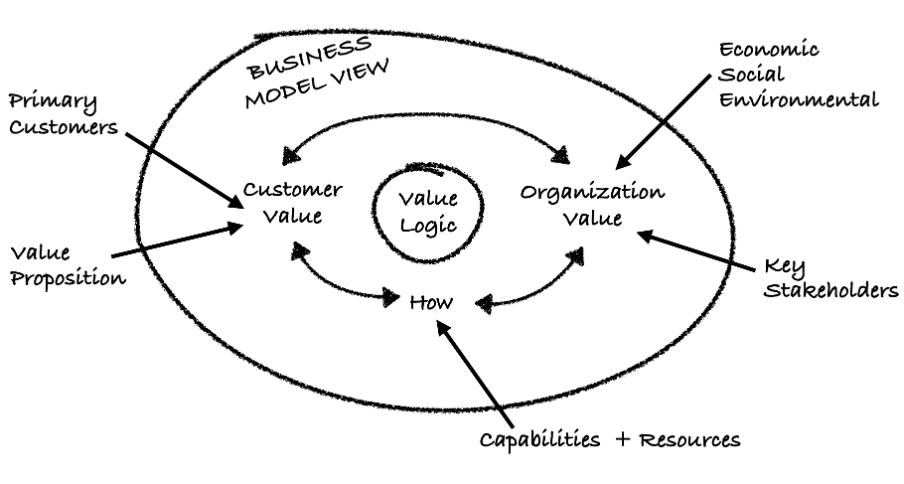
The practical implication of this iterative process is that having chosen the Primary Customers and the Value Proposition to be offered to those Customers, if the appropriate mix of Excel and Table Stakes Capabilities + Resources does not already exist, cannot be developed internally or readily acquired from outside the organization, then it’s time to start over again. Primary Customers, the Value Proposition, the expected Organization Value, and the Capabilities + Resources System all need to be reconsidered until they come together into a Business Model that demonstrates:
– Coherence: It must make sense, it must demonstrate a logical, consistent and concise pathway from How to the Who, What and Why of Customer and Organization Value Creation.
– Integration: The components must all fit together and must be mutually reinforcing.
- Value Logic Dominance: One of the three generic Value Logics should be clearly dominant with the other two having less significance.
Maintain Existing Value Creation While Integrating Business Model Innovation Ideas
As I previously mentioned, in an existing business, SCIP starts with reverse designing the existing Business Model. SCIPgoes on to identifying opportunities to innovate that Business Model to improve Value Creation. The ‘Strategy Challenge’ at this stage is to keep the existing Business Model ticking along while, at the same time, integrating Business Model Innovation ideas that have the potential to realize additional, sustainable Value Creation.
Balancing the ‘new’ with the ‘existing’ is always difficult, especially in larger organizations. Some people embrace change. They go all in on the new ideas and pay little attention to the existing business. Others are resistant, preferring to stick with what they’ve always done in the past.
So, in SCIP, I frame Business Model Innovation ideas as Strategy Projects that overlay the existing Business Model and use Project Management concepts and tools to manage the transition from the existing Business Model to the new Business Model.
There are three important benefits to this approach. First, it maintains focus on the existing business, which is, after all, the major source of revenue and profits. Second, by establishing appropriate Project Teams to manage and integrate Business Model innovation ideas, support and momentum for the relevant changes can be built across an organization. Third, senior executives can use Project Management tools to track progress, to ensure an appropriate balance is kept between the existing and the new and to make revisions where appropriate.
Look for What Not To Do
What falls out of identifying the Excel and the Table Stakes Capabilities and Resources is usually activities that can be stopped, products or services that can be phased out, assets that can be divested. But, as I mentioned previously, people often struggle to stop doing what they’ve always done. Again, Project Management can play an important role as a mechanism to manage ‘what not to do’ in the same way that it does with ‘what to do’.
Summary: The ‘How’ component of the Business Model View is the system of Capabilities + Resources that a firm uses to create Customer and Organization Value. ‘How’ is first described generically using the Value Logic typology. From there, ‘How’ is designed in the context of the firm’s Business Model by identifying the specific Capabilities and Resources needed to deliver those Dimensions of Customer Value where the firm chooses to Excel and those where it chooses to meet Table Stakes.
The challenge is to keep the existing Business Model ticking along while, at the same time, integrating Business Model Innovation ideas that have the potential to realize additional and sustainable value creation. The concepts and tools of Project Management are critical, not only to integrating new ideas but also to phasing out activities, products and services that no longer create value.

 Strategy Conversations In Practice
Leave a comment