Strategy is Execution………Execution is Strategy
Strategic Planning has a lot to answer for. One of its major flaws is the notion that formulating strategy and executing strategy are conceptually and practically distinct activities, that senior managers analyse and plan and then hand down that plan to those lower in the organization who are meant to implement it exactly as planned.
This thinking has led to hundreds, maybe thousands of posts, articles and books over the last 25 years on how to prospectively ‘close the strategy — execution gap’, the potential shortfall between a firm’s actual results and its expected results. Common ‘recipes’ to address this potential shortfall draw on topics such as alignment, resourcing, communication, culture, agility, organisational structure, leadership, training, capabilities, performance reviews, setting better targets………and the list goes on…….and on….and on!!
Distinguishing between strategy and execution is a convenient way for senior executives to shift blame down the ranks when their ‘good’ ideas fail to deliver the expected results. And it’s certainly a rain maker for consultants but, as Roger Martin has argued many times, it doesn’t make sense. Many of the recipes for what is called ‘good strategy execution’ actually involve strategy formulation so how can they be conceptually and practically different??
In Strategy Conversations in Practice (SCIP) there is no distinction between strategy formulation and strategy execution. Strategy is defined as the pattern realized in the choices a firm makes in aiming to creating value for its Customers and for itself. Strategy is framed in terms of choices on Customer Value, Organization Value and How these ‘buckets’ of value are created, and expressed in the form of a coherent, integrated, cause and effect Business Model View that is unique to the firm in question. At the center of this Business Model View is a clear and concise Value Logic that integrates each of the components.
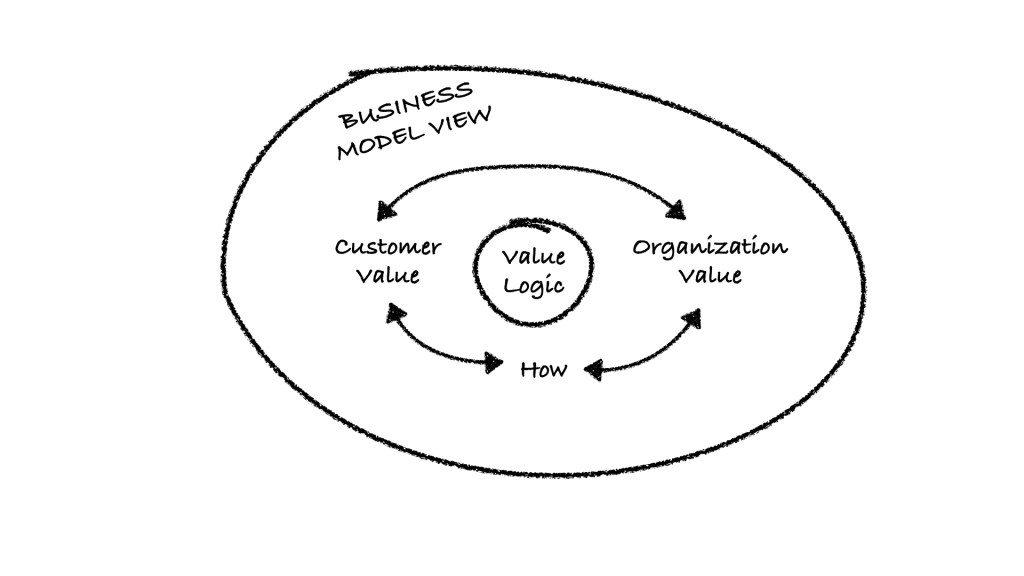
This Business Model View represents strategy in action, not a plan and not the ‘laundry lists’ of activities so commonly seen in Strategic Planning. The underlying premise is that strategy is what firms do, not what they say. A firm’s Business Model represents its strategy and its execution.
To put it another way, in SCIP execution is strategy….and strategy is execution. The strategy process in SCIP involves a continuous learning loop of four distinct but interconnected, iterative, and reflective Conversations with the Business Model View at the core of the loop, as a touchstone for each Conversation and the collective output of all four Conversations. Strategy choices are made in each of these Conversations and are continuously revised as an organization moves through the loop.
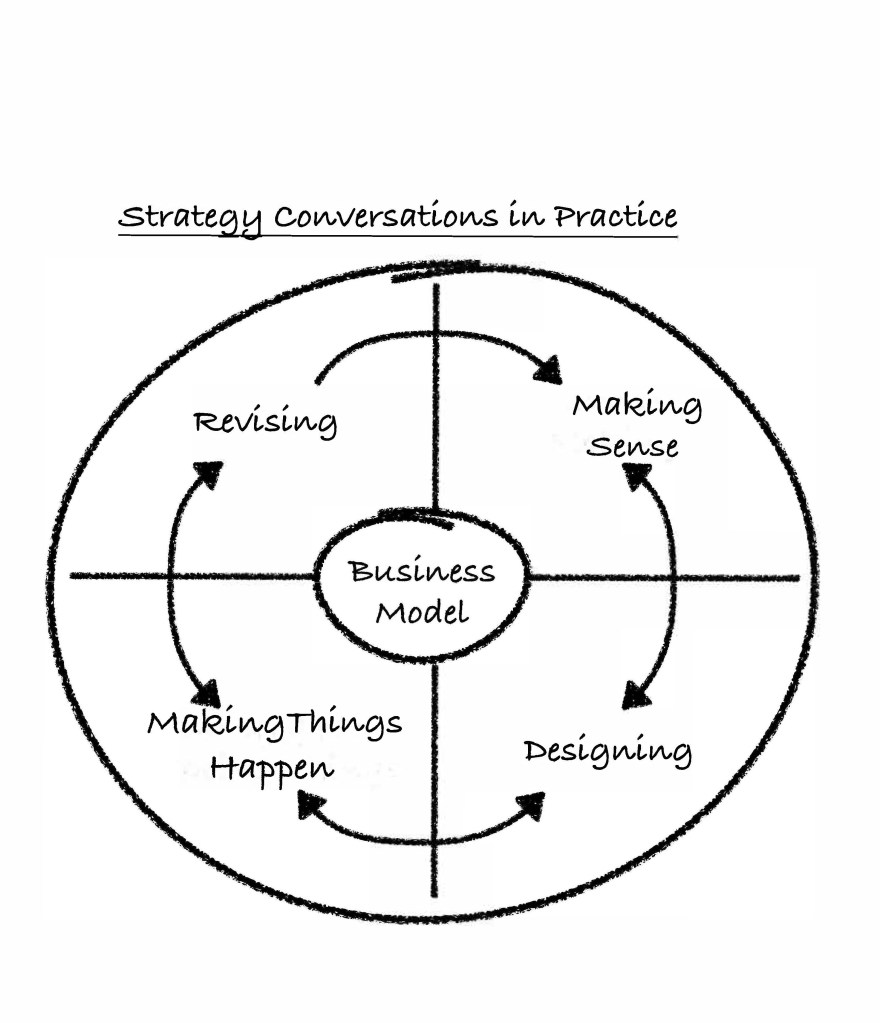
So far in the Better Business Strategy series I’ve written about strategy choices in Making Sense and in Designing Strategy Conversations. In this Post I will draw on the principles of Project Management to write about strategy choices in the Making Things Happen stage of SCIP.
Making Things Happen Strategy Conversations focus on moving from a firm’s existing Business Model towards a new Business Model prototype(s). The major challenge in Making Things Happen is to ensure that this integration is a positive sum exercise. In other words, gains in Customer and Organization Value Creation from integrating new ideas into the existing Business Model exceed any declines in performance by that model.
Two steps are critical in this stage of SCIP:
- Developing a Strategy Narrative in parallel with a Business Model View for a future in which select Horizon 1 and 2 Business Model Innovation Ideas (from the Designing Conversations stage) are integrated with the existing Business Model.
- Project Managing these Horizon 1 and 2 Ideas — framing them as Strategy Projects, and then planning, refining and integrating them with the existing Business Model to the point where the proposed (future) Business Model is realized in practice.
Strategy Narrative: A Strategy Narrative is not another fluffy Vision or Mission statement, it’s not a goal statement, and it’s certainly not a ‘laundry list’ of loosely connected activities that have little to do with Customer Value Creation. Nor is it a huge slide deck prepared by a team of consultants and delivered by the CEO in a ‘dog and pony show’ to employees, analysts and other stakeholders.
A Strategy Narrative is a short story, a clear and concise statement that explains in plain English, without buzz words and fluffy hyperbole, an organization’s proposed Business Model. It is a ‘word picture’ that complements an organization’s Business Model View.
A Strategy Narrative is intended primarily for internal use. It should spell out the Who, What, How & Why of Customer and Organization Value that the firm is aiming to create. It should also guide the choices people within the organization routinely make each day — what to do, what not to do — and link these choices back to the organization’s proposed Customer Value and Organization Value Creation.
Most importantly, a Strategy Narrative spells out, either implicitly or explicitly, in the context of the firm in question, the dominant Value Logic that underpins its proposed Business Model.
Project Management of Horizon 1 and 2 Business Model Innovation Ideas: As I mentioned earlier, the challenge in Making Things Happen Strategy Conversations is to ensure that integration of Horizon 1 and Horizon 2 ideas into a firm’s existing Business Model is a positive sum exercise.
In SCIP, I frame Business Model Innovation ideas as Strategy Projects and use Project Management disciplines to facilitate the integration process. In SCIP Strategy Projects represent new choices. They are pockets of work aimed at improving Customer and Organization Value Creation. Horizon 1 and 2 Strategy Projects are conceptualised in Designing Strategy Conversations, and then planned, refined and integrated with the existing Business Model in Making Things Happen Conversations.
Strategy Project Planning involves all the typical steps — resourcing, accountability, milestones, risk assessment, outcomes etc all wrapped up into a Business Case for each project. Horizon 1 and 2 projects are typically led by operational managers. Why? Because they’re at the coal face, they’re implementing the current Business Model, and they will know best how to make changes to that model to create value in practice.
Operational managers should have the freedom to experiment with and refine Strategy Projects as they evolve or even to send them back into the Designing Conversations stage if appropriate. It’s also important to recognize that operational managers must constantly juggle business as usual activities with their work on Strategy Projects. This has implications for workloads, performance assessments and rewards.
Senior management, and/or the board’s role in Making Things Happen Conversations is to oversee the portfolio of Strategy Projects, to establish priorities and allocate resource in line with value creation opportunities, and especially to choose which Projects to continue with and which ones to drop. Getting the timing right is also a critical consideration. I’ll write more about the board’s role in Strategy Projects in a future post.
Consider Bunnings as a retrospective example of what these two steps might look like. To reiterate, Bunnings is a business unit of Wesfarmers, a publicly listed Australian conglomerate renowned for its financial discipline and management of its portfolio of business units. Bunnings currently operates around 400 ‘big box’ retail outlets in Australia with annual revenue more than $A18 billion and a CAGR over the last 25 years of around 15%. Bunnings’ earnings have grown even faster in that period. It is a highly successful business!
This is my take on the Bunnings Business Model that has evolved over the last 5 years.
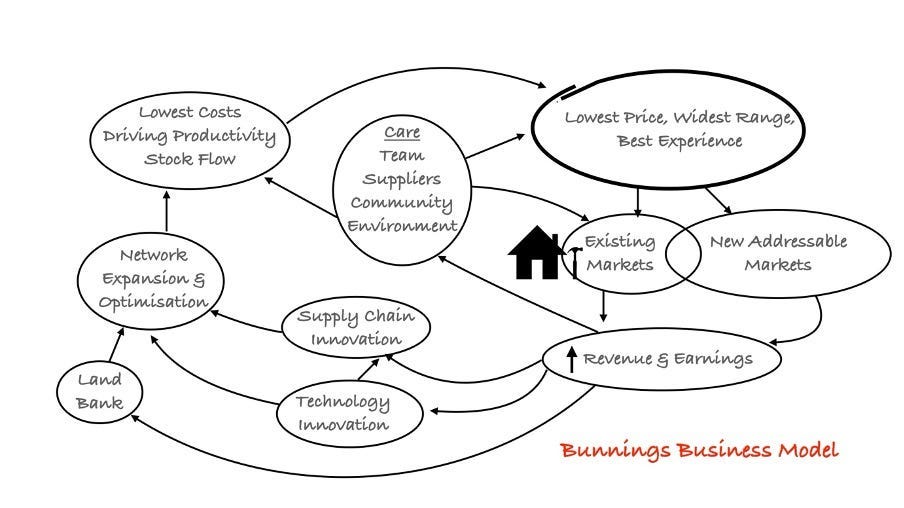
And this is my take on the Strategy Narrative that has guided Bunnings over that 5 year period.
Our Primary Customers are DIY households, tradies and small contractors. We help them to maintain, renovate, decorate, protect and enjoy homes and gardens. We offer the lowest prices, widest range and best experience in a constantly evolving suite of products and allied services. Our scale in stores and digital footprint, our operating efficiencies, our suppliers’ partnerships, our investment in technology and innovation, our investment in attracting, training and retaining people with DIY and trade expertise, and our focus on supporting local communities are critical in maintaining and growing our business.
The application of Strategy Project Management to Business Model Innovation is best understood through a practical example in Bunnings. In the 2023 Strategy Briefing to analysts Bunnings talked about their track record of growth by expanding their ‘addressable markets’ while at the same time delivering projects aimed at transforming the existing Business Model. The slide below titled ‘While Delivering Transformational Projects Over Past 5 Years’ is taken from that briefing.

Note that Bunnings have implemented only 22 projects over 5 years. Bunnings knows how to focus. I’ve seen many examples from firms stuck in the Strategic Planning paradigm with 50+ projects on their ‘laundry list’ each year. It’s no wonder they don’t get anything done.
I’ve reverse engineered these ‘transformational projects’ into Horizon 1 and 2 Business Model Innovation:
Horizon 1: 15 Projects in total. Some examples include ‘Launched Click and Collect/Deliver’; ‘Launched Drive and Collect’; ‘Opened Laverton Fulfilment Centre’; ‘Implemented Enterprise Data Platform’; ‘ERP to Cloud’. Each of these Projects aimed to deliver lower total cost to Customers (especially convenience) and increased volume/lower costs for Bunnings.
Horizon 2: 7 Projects in total, all aimed at expanding into adjacent markets. Two of these were acquisitions — Adelaide Tools & Beaumont Tiles, and one was a rebranding exercise — Tool Kit Depot. Four were product range expansions or new product ranges — Garage Storage, Moving Home, Frame & Truss, Pet Care.
It’s worthwhile mentioning the approach that Bunnings has taken with Adelaide Tools, a specialty tools chain aimed at “tradies and hardcore-DIY-ers” acquired in one state in 2019. The value proposition is more about expert advice and high-end tools than widest range — lowest prices. So, instead of folding it into the Bunnings business, Adelaide Tools was initially maintained as a separate entity, and after testing out new concepts in one store, it was rebranded as Tool Kit Depot and new stores rolled out. The stated aim is to expand to 75 stores nationally, but the staging is deliberately slow and geographically focused to recognize the different ‘Who and What’ Value Proposition compared to the core Bunnings business.
*********
Making Things Happen Strategy Conversations are not solely about strategy execution. The notion that strategy formulation and strategy execution are conceptually, and practically distinct activities is one of the fairy tales of Strategic Planning. In the real-world Strategy is what firms do to create value. Strategy is not a plan nor is it a ‘laundry list’ of activities. Strategy is a firm’s Business Model, one that is continuously evolving. Strategy is execution and execution is strategy.
Making Things Happen Strategy Conversations focus on moving from the existing Business Model towards a new Business Model prototype(s). These Conversations involve planning, refining and integrating a portfolio of Horizon 1 and 2 Business Model Innovation ideas with the existing Business Model. Framing these Business Model changes as ‘projects’ and using Project Management disciplines to ‘make them happen’ is critical.
 Strategy Conversations In Practice
Leave a comment