Revising Strategy Conversations: Better Business Strategy IV
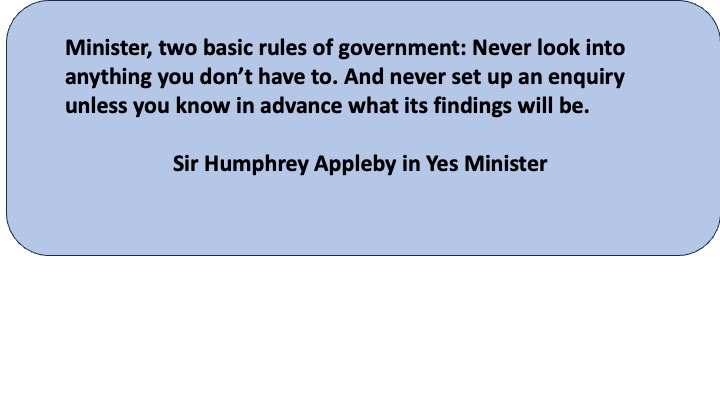
In the world of Business Strategy, the parallel to Sir Humphrey’s ‘government enquiry’ is typically called a Strategic Review, a one-off, focused and intensive response to major performance issues. Like ‘government enquiries’, Strategic Reviews are often more about organizational politics and assigning blame for problems than about improving performance. And they’re more about justifying changes that have already been decided rather than finding new opportunities.
The precursor to a Strategic Review is often the termination of the CEO — who leaves quietly with a ‘bag of gold’. This change is usually driven by a board of directors with their own ideas about the performance issues and the strategies that should be in place to address them. Next a new CEO is appointed and a Strategic Review is announced. It usually involves months of analyses to justify and flesh out the strategies that have already been decided, followed by cost cutting, asset sales, terminations, reorganization etc etc. But the problem is
Most Strategic Reviews hinge on the misguided notion that planning and strategy are the same thing
Strategic Reviews are typically ‘poor performance’ driven episodes of Strategic Planning (as opposed to calendar driven). They involve all the problems I’ve talked about previously in the Strategy Conversations in Practice(SCIP) series (see Disappointed with Strategic Planning, Try Strategy Conversations Instead and Where is the Business Model in Strategic Plans). In particular, their output is typically a laundry list of fragmented threads of activities mislabeled as strategies and aimed at creating value for the firm itself rather than for its Customers.
To make matters worse these so-called ‘strategies’ are overlaid with cognitive biases on the part of those who initiated the Review. Their focus is usually on shareholder value and on keeping their well-paid jobs.
Finally, Strategic Reviews are reactive. By the time a Review is completed, it’s usually too late. The horse has already bolted!! A Strategic Review might keep a firm alive in the short term, but it is not surprising that the cycle usually repeats itself a couple of years later.
So, what’s the alternative? In SCIP, I argue that strategy is a focused, coherent and integrated set of Customer and Organization Value Creation choices that are continuously reconfigured through a learning loop of four distinct but interconnected, iterative, and reflective Strategy Conversations. Revising Strategy Conversations are the fourth stage in this loop. The other stages are here, here and here.
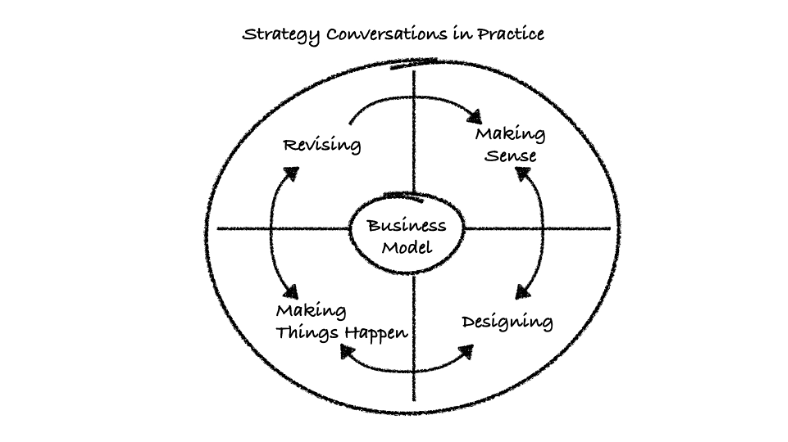
Revising Strategy Conversations involve continuously assessing:
– Conditions for Success.
– Customer and Organization Value Creation performance relative to expectations.
– Progress with the Horizon 1 and Horizon 2 Business Model Innovation Projects initiated in Making Things Happen Conversations.
Conditions for Success, or What Would Have To Be True (Roger Martin) are the conditions that must be in place for a Business Model to successfully deliver Customer and Organization Value expectations. Conditions for Success are reverse designed from the prototype Business Models developed in the Designing Strategy Conversations stage. They include macro environment, industry, market and competitive factors as well as factors specific to a firm’s Business Model.
Once specified, these ‘conditions’ should be continuously compared with what is happening in the real world. The aim is to identify key differences as they emerge and synthesize insights into potential changes to the firm’s Business Model.
Customer and Organization Value Creation expectations are also developed in the Designing Strategy Conversations stage and refined in the Making Things Happen Conversations stage. A Revising Strategy Conversation starts with actual outcomes versus those expectations and asks if and why there are gaps. This Conversation uses the Business Model View to frame the Who, What, Why and How of Value Creation choices that have been made and assesses the actual firm performance against those choices.
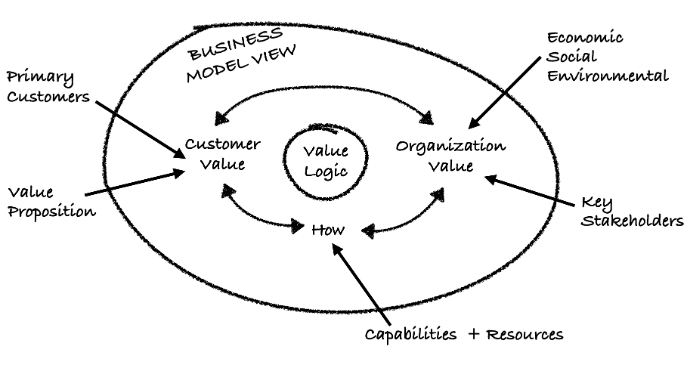
Typical questions that should be asked on a continuous basis in Revising Strategy Conversations include:
– Primary Customers: Are we gaining/losing/maintaining those Customers we targeted?
– Value Proposition: Are we excelling in the chosen dimensions of Customer Value? Are we meeting Table Stakes in others?
– Organization Value: Are we meeting expectations in terms of the key financial and non-financial value dimensions?
– How: Are we focused on, investing in and continuously improving the Capabilities and Resources needed to deliver the ‘excel’ value dimensions? Are we maintaining the Capabilities and Resources needed to deliver Table Stakes value dimensions. Are we wasting investment, time and effort in areas that don’t matter?
– Value Logic: Is it clear, concise and dominant? Or, are we trying to be all things to all Customers?
Again, the aim is to identify areas of divergence from Customer and Organization Value expectations and synthesize insights into potential changes to the firm’s Business Model.
Horizon 1 and Horizon 2 Business 2 Business Model Innovation Projects: Typical questions include are we meeting the targets and milestones set in each project’s Business Case? If not, why and what are the implications? Are we successfully integrating business as usual with these projects?
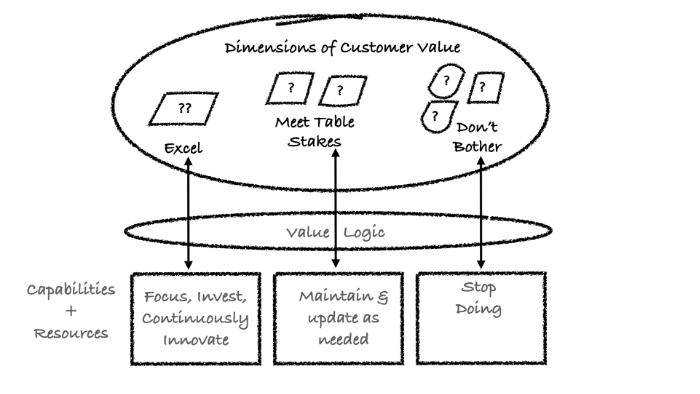
The aim at this point in a Revising Strategy Conversation is to gain insight into the changes that need to be made to the project portfolio and/or the projects themselves.
Change the Business Strategy……Change the Strategy Projects?
If any of the Conditions for Success are not true or they’re not heading that way, if Value Creation results are well below expectations, then the firm’s Business Strategy needs to change. It’s time to move into a new Making Sense Conversation aimed at developing a new Business Model.
If the Conditions for Success are heading in the expected direction, if Value Creation results are meeting expectations, then the firm’s Business Strategy is on the right course. But this doesn’t mean the firm stands still. Rather, it means it’s time to improve the current Business Model by looking for opportunities to refresh the portfolio, implementation and integration of Horizon 1 and Horizon 2 Business Model Innovation projects
How often should firms hold Revising Strategy Conversations? They should not be an annual ritual like Strategic Planning! The reality of today’s business world is that firms need to be prepared to continuously reconfigure their value creation choices.
Firms that stick their heads in the sand will get their butts kicked
Holding Revising Strategy Conversations often should be a habit in all organizations. They don’t have to be intense and time consuming like Strategic Reviews. A continuous routine of reflecting on Conditions for Success, on Customer and Organization Value Creation performance relative to expectations, and on progress with the Horizon 1 and Horizon 2 Business Model Innovation Projects initiated in Making Things Happen Conversationsis one key. Another is the mind set to learn from these reflections to change the Business Model and/or change the Strategy Projects?
To paraphrase a quote often incorrectly attributed to Winston Churchhill:
However beautiful the strategy, you should always look at the results and be prepared to learn from them……not once a year, not once a quarter….but continuously.
 Strategy Conversations In Practice
Leave a comment