Insanity is doing Strategic Planning over and over again and expecting a different result. ……………………………With apologies to Albert Einstein
Strategy Conversations are not facilitated love ins, nor are they corporate theatre, and they’re certainly not exercises in plastering the walls of conference rooms in fancy hotels with flip charts and Post-It notes that never see the light again!……………………………………………………………Client X
In Post 1 of this series (Disappointed with Strategic Planning? Try Strategy Conversations in Practice Instead) I discussed the problems with Strategic Planning and introduced Strategy Conversations in Practice (SCIP) as an alternative framework, a way to develop better Business Strategy by continuously reconfiguring the value creation choices an organization makes. To recap on the problems of Strategic Planning:
- Too much analysis and planning, too little insight into what really matters.
- Overreliance on predicting the future by extrapolating the past.
- Producing a ‘laundry list’ of fragmented threads of activity and calling them strategies.
- The ‘Execution Myth’, the crazy notion that a firm can have good strategy but poor results because of poor execution, which is really an exercise in shifting blame.
- And, most importantly, Strategic Planning does not adequately recognize Customers, the importance of creating Customer Value and how that Value is linked to Organization Value creation.
In this Post I will outline the Strategy Conversations framework in more detail and the concepts that underpin it. In later Posts I’ll go through each Conversation in detail.
So, let’s start with what Strategy Conversations are not.
Strategy Conversations ARE NOT facilitated workshops like those popular in the world of Strategic Planning. They are not management retreats at fancy resorts or corporate love ins where expensive ‘bonding exercises’ are briefly punctuated by superficial talk of strategy. And they’re not exercises in populating the templates of strategic management tools (another SWOT analysis — really??), nor in plastering flip chart pages and post-it notes all over the walls of conference rooms, generating long lists of disconnected activities that masquerade as strategy but will be ignored a few days later when everyone gets back to their ‘real work’. And Strategy Conversations ARE NOT calendar dependent, they ARE NOT linked to or driven by the annual budget cycle.
In case there is any doubt, Strategy Conversations ARE NOT another example of the ritual rain dance that is Strategic Planning!!
Strategy Conversations ARE continuous dialogue on the choices an organization makes or might make to create Customer Value and to share in that value. Strategy Conversations may be formal or informal, one on one or in small groups (no more than 6 to 8 so no one can hide) with hierarchies parked at the door (so no one can hijack the discussion), short or long term in orientation, within or between organizational levels or functions and may involve both insiders and outsiders to the firm.
Strategy Conversations ARE a learning loop of four distinct but interconnected, iterative, and reflective stages with the Business Model View at the core of the loop, as a touchstone for each Conversation and the collective output of all four Conversations. The time frame in which a firm moves around the loop is flexible, it depends on changes in its context and its Value Creation performance.
Making Sense Strategy Conversations aim to open up the ‘black box of strategy making’, to turn analysis into insight, to ‘see’ what really matters for a firm’s Business Strategy. More specifically, Making Sense Conversations aim to understand ‘what is’ and ‘what might be’. Understanding ‘What is’ involves reverse designing a firm’s existing Business Model, understanding its context and performance, and synthesizing this information to gain insight into the unique strategy opportunity, problem or question it faces. Understanding ‘What might be’ involves imagining the firm’s ‘Alternative Futures’ in which this unique opportunity, problem or question may be resolved.
Designing Strategy Conversations aim to translate each ‘Alternative Future’ into a coherent and integrated Business Model prototype using the concepts and tools of Design and Innovation, testing these prototypes for their potential to create Customer and Organization Value, and then refining, and retesting them until finally making choices. A key part of this Conversation is answering Roger Martin’s question ‘What Would Have To Be True’ to win, what are the Conditions for Success of the chosen Business Model prototype. These might include macro, industry, market, and competitive factors as well as those specific to the Business Model prototype under consideration. Note that Conditions of Success are NOT the same as assumptions. The former are grounded in a future Business Model, the latter are grounded in the existing Business Model and its history.
Making Things Happen Strategy Conversations focus on moving from the existing Business Model towards the chosen Business Model prototype. More specifically, they involve fine tuning and integrating a portfolio of Business Model Innovation ideas with the existing Business Model. A key challenge is doing this while at the same time ensuring the integration is a positive sum exercise. In other words, gains in Customer and Organization Value Creation from the changes exceed any declines in performance by the existing Business Model. Framing these Business Model changes as ‘projects’ and using Project Management disciplines to progress them is critical in this stage. An important choice in these Conversations is always what to stop doing and how to ensure this happens. Old habits usually die hard!
Revising Strategy Conversations involve continuously tracking actual Customer and Organization Value Creation performance relative to expectations, Conditions for Success (are they moving in the right direction), and progress with the Strategy Projects initiated in the Making things Happen Conversations. The key questions at this stage are — does the firm stay the course? Does the firm move into a new Making Sense Conversation (to make changes to the Business Model)? Or does the firm move back into a new Making Things Happen Conversation (to refresh the portfolio of Strategy Projects)?
Each of these Strategy Conversations will be covered in more detail in future Posts.
I should emphasize at this point that I don’t see SCIP as a new strategy framework. I see it as a synthesis of what is already out there with an emphasis on Strategy as Design, as Innovation, and as Practice.
Strategy as Design applies a Design Thinking lens to the Business Model choices at the core of SCIP. More specifically, Strategy as Design relies on an in depth understanding of Customers — who they are and why they purchase your product or service (their Job to be Done) — and how your firm might satisfy that Job. These steps primarily involve using qualitative techniques such as Customer interviews and observation and visual and experiential design tools to simplify complex problems and generate possible choices. Strategy as Design especially involves integrating these choices into alternative, holistic systems (Business Model prototypes) of value creation.
Strategy as Innovation applies Exploitation and Exploration lenses to the Business Model Choices at the core of SCIP. ‘Exploitation’ focuses on Horizon 1 ideas, on continuously enhancing the current Business Model, on refreshing the current Value Proposition and improving ‘How’ to deliver that Value Proposition. ‘Exploration’ focuses on Horizon 2 and 3 ideas, on discovering and validating adjacent and completely new Customers, their Jobs to be Done, alternative Value Propositions, Business Model discovery, iterative testing and subsequent scale up.
The aim of both Strategy as Design and Strategy as Innovation is to inform Who, What, Why and How choices about Value Creation and to integrate these choices into a holistic system, a Business Model that can be tested, scaled up and subsequently revised on an ongoing basis. Both Strategy as Design and Strategy as Innovation are focused on creative solutions to strategy opportunities, problems or questions. Both involve ‘messy’ processes that iterate through uncertainty in a non-linear manner before finally reaching clarity and focus. Importantly, neither is ever complete. Rather, they evolve in line with changing Customers and Jobs to be Done, firm performance, competitors, and overall firm context. As such, both lenses are ideally suited to the ‘strategy learning loop’ inherent in SCIP.
Strategy as Practice studies what strategists do as opposed to the effects of strategies on firm performance. The word ‘Practice’ is critical in SCIP. In those firms that rely on Strategic Planning it’s a ritual that generally happens once a year in a highly formalised manner. It’s more form than substance. Firms devote significant effort to it but learn little from it. Often, participants can’t wait to get the annual Strategic Planning cycle over and done with so they can get back to their real work, the stuff they believe really matters!
However, in other firms, informal Strategy Conversations happen on a frequent basis. They are recognized as important work! They may not be formally labelled the same as the stages in SCIP, but they nonetheless involve making strategy choices. These Conversations start by recognizing that Customer Value expectations change for a wide variety of reasons and that it is important to make sense of changes early, to understand why and how they’re happening, to understand their Business Model implications, to make appropriate changes to that Business Model and to reflect on the effects of those changes before starting the process all over again as necessary.
In these organizations this process happens frequently because they don’t think about strategy as an annual plan but rather as an evolving system or pattern of choices made at all organizational levels and aimed at creating Customer and Organization Value. In effect, these organizations ‘practice’ Strategy Conversations and they continuously learn from them before they go onto the next cycle. Why is practice important? Because practice informs what they do next, the aim of practice is to learn how to get better. And the more often firms practice Strategy Conversations, the better they get at making strategy choices.
The differences between SCIP and Strategic Planning are summarized in the table:
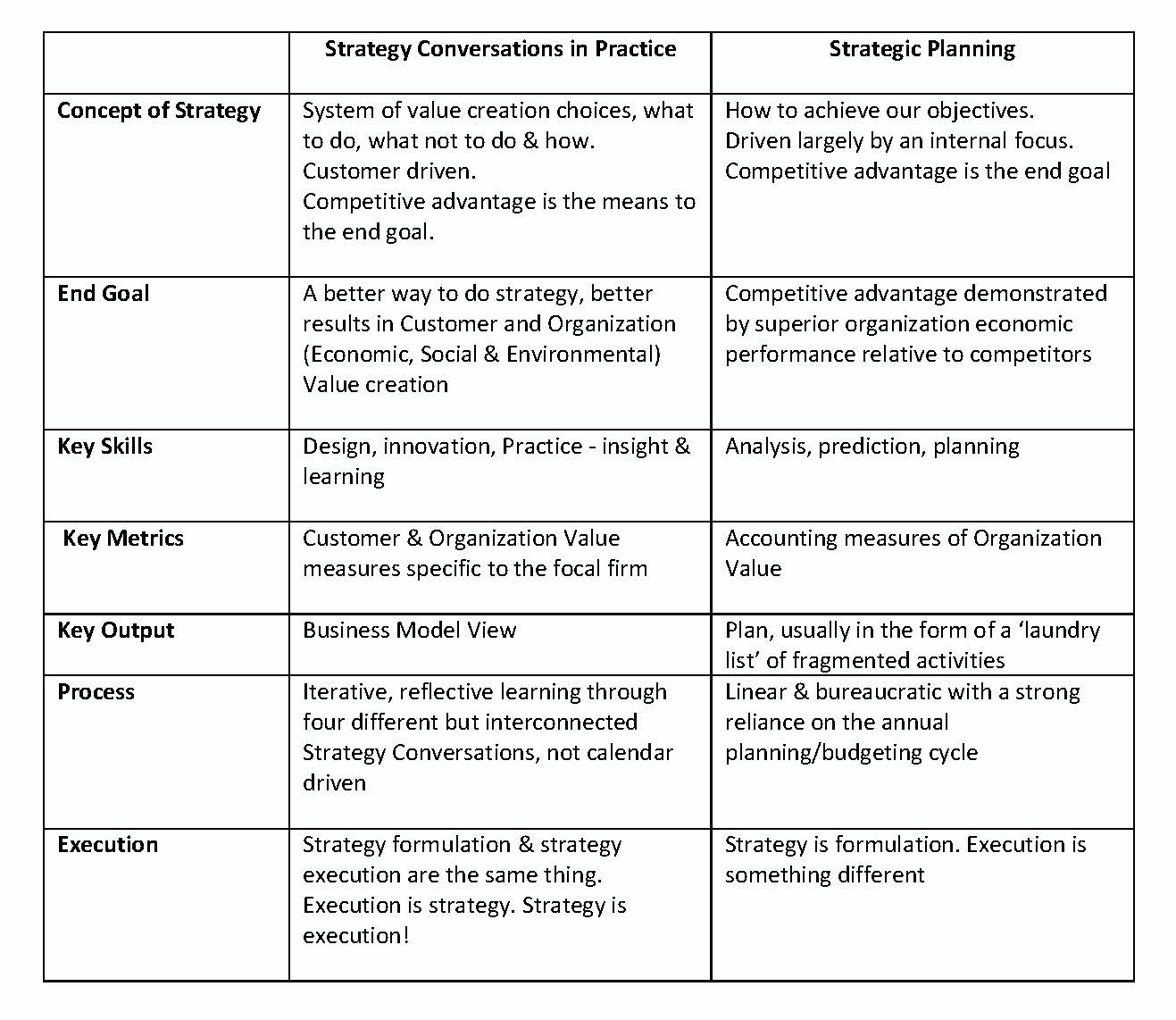
But is SCIP a better way to do strategy? Does SCIP lead to better strategy, to better results in Customer and Organization Value Creation? Intuitively, my answer to both questions is yes but I doubt that anyone will ever be able to empirically prove it. In the real world of strategy, judgment calls on the part of the executives involved play a big role, one that cannot be adequately captured as independent variables. However, there is a growing body of practitioner literature that highlights the link between similar frameworks and better strategy and results.
In 1995 Michael Treacy & Fred Wieresma published a book called The Discipline of Market Leaders. Their mantra was “Choose Your Customers, Narrow Your Focus, Dominate Your Market”. They argued that firms outperform their competitors by carefully choosing their target Customers, focusing tightly on the dimensions of value those Customers expect, delivering those dimensions of value to a level that competitors cannot match and continuously improving on that value year after year.
In 2010, Leinwand and Mainardi in an article titled ‘The Coherence Premium’(Harvard Business Review), argued that sustainable and superior economic returns accrue to companies who understand how they create Customer Value, who focus intensely on the capabilities system that delivers this value, and who ensure that all products, services and activities fit closely together.
Similarly, in 2011 Zook and Allen in ‘The Great Repeatable Business Model’(Harvard Business Review), argued that successful companies understand their ‘differentiators’, why Customers buy their products/services, and focus on developing and adapting the organizational routines, behaviors and activity systems that enable these differentiators.
Roger Martin, in his posts, articles and books on ‘Playing To Win’, has argued that successful strategy is underpinned by a theory that explains the choices made, a theory that is grounded in ‘serving customers better than anybody else’, is coherent and able to be readily translated into action.
On the other hand, in 2017 Freek Vermeulen argued that ‘Many strategies fail because they’re not actually strategies’. They don’t involve a clear and coherent set of choices on what to do and what not to do. Similarly, in 2021 Collis argued in ‘Why Do So Many Strategies Fail’(Harvard Business Review) that poor performance happens because CEOs don’t take a holistic approach to strategy, they don’t recognize that strategy “requires an aligned set of decisions about which opportunities to pursue, how much value the firm can create and capture, and how to keep realizing value and build a foundation for long-term success”.
It’s hard not to accept these arguments. After all, they seem like a blinding flash of common sense! And it’s reasonable to expect that similar arguments will apply to a firm’s social and environmental value creation performance provided the relevant choices are made.
Strategy as a continuous learning loop, an ongoing, reflective practice that has coherent and integrated Business Model choices at its core, that recognizes the end goal is Customer and Organization (Economic, Social and Environmental) Value Creation, that sees competitive advantage as the means to that goal, that preferences Design and Innovation over analysis and planning, that recognizes there is no distinction between strategy and execution……these are all ideas that enable better strategy and better results.
In future Posts I plan to present examples of these ideas in action using real world cases. .
Summary: Strategy Conversations in Practice involve continuously reconfiguring the value creation choices an organization makes. While SCIP draws on analysis and planning concepts and tools the framework preferences those of Strategy as Design and Innovation. SCIP requires skilled judgment calls that can only be learned through repeated practice. Its core proposition is that a coherent and integrated pattern or system of contemporaneous choices — what to do, what not to do — grounded in Customer and Organization Value Creation and continuously reconfigured through a learning loop of four distinct but interconnected, iterative, and reflective Strategy Conversations produces better Business Strategy and better firm results.


 Strategy Conversations In Practice
Leave a reply to Want Better Strategy? Start With Making Sense Strategy Conversations – Strategy Conversations In Practice Cancel reply