Who, What and Why of Customer Value— Part I
Our highest priority is satisfying our customers………except when it is hard……..or unprofitable………or we’re busy.
Dilbert
Every time I see or hear the words ‘strategy’ and ‘customer centric’ linked together my BS barometer goes off. Some (many?) businesses love to talk about being ‘Customer centric’ but don’t act that way. These firms are usually caught up in the Strategic Planning paradigm. They focus on what they can control, which is generally internal activities and measures. They know lots about their costs but nowhere near as much about their revenue. Revenue is driven by Customers and Strategic Planning is poor when it comes to understanding Customers. So, they rely on platitudes like being ‘customer centric’ to get across the message that they care about Customers. They even have Customer Care departments, but their actions suggest otherwise. Maybe they should change the name?
You’ve reached the Customer Don’t Care call centre…….
Airlines are a classic example. Not so long ago, I had a problem with Air Canada. To cut a long story short, Air Canada changed the flight reservations I had made months earlier. The airline advised the details via email and gave me an international phone number to ring if I was not happy with the new flights. After a week of trying at all hours of the day and night with no answer I gave up and rang the local (Australian) agent for Air Canada. They couldn’t help because I had booked on the internet.
But they gave me an email address for the Customer Care department, so I contacted them and explained the problem. They responded via email to the effect that Customer Care looked after problems after flights were taken, Reservations looked after problems before flights were taken. “But Reservations don’t answer the phone” I said, more than a little frustrated. Anyway, it took another four emails before Customer Care finally fixed the problem. When I told a friend in Canada about it, he laughed and said “Don’t you know Air Canada’s motto……”
We’re not happy until you’re not happy.
Qantas, the Australian flag carrier, the Flying Kangaroo, makes Air Canada look like ‘Customer centricity’ experts. Qantas has long traded on its image as the Spirit of Australia with great advertising campaigns such as I Still Call Australia Home and Feels Like Home. They’re warm and fuzzy and make you think that Qantas will treat you like a king.
Qantas announced a record profit of $A2.5 bill for the year ending June 2023!! But in March 2023, the Australian Competition and Consumer Commission (ACCC) announced that Qantas was the most complained about company in Australia in the prior year. Despite the excellent financial results, Customers were, and still are, not happy about ticket prices, flight delays, lost baggage, long queues in terminals, problems in redeeming flights credits from the Covid era, the lack of availability of flights for frequent flyer redemptions, unanswered phone calls…….
Qantas is also in trouble on other fronts ranging from unions, employees, a High Court decision about unfairly firing workers, executive compensation, corporate arrogance, anti-competitive matters, and political influence. But these are matters for another story about Organization Value.
This story is about Customer Value and the latest issue for Qantas is the announcement on 31st August that the ACCC launched action in the Federal Court alleging that:
……. for more than 8,000 flights scheduled to depart between May and July 2022, Qantas kept selling tickets on its website for an average of more than two weeks, and in some cases for up to 47 days, after the cancellation of the flights…….
While it’s only an allegation at this stage, this announcement, coming on the back of the earlier problems, triggered a fire storm of criticism. On 5th September, Alan Joyce, the Qantas CEO for 15 years, who was due to retire in November, announced his immediate retirement. Joyce’s designated replacement, Vanessa Hudson (an internal promotion), began on the 6th September and issued a video apology to all Customers on 22nd September This is an excerpt from it:
………We understand we need to earn your trust back, not with what we say but what we do and how we behave. This is going to take time and I ask for your patience. The work is already underway: we’re putting more people in our call centres to help solve problems faster, we’re adding more frequent flyer seats, we’re reviewing all of our customer policies to make sure they’re fair and we’re giving our frontline teams more flexibility to better help you when things don’t go to plan.
While Hudson didn’t use the words this looks suspiciously like a small step towards being more Customer Centric. But is it strategy? Or is it an attempt to put out spot fires while a major bush fire is just over the hill?
Being Customer Centric Is Not Strategy
Why do I say this? Being Customer Centric is an important but generic principle underlying all three Value Logics in Strategy Conversations in Practice (SCIP). It’s application will vary across the three Value Logics but it’s a principle that, as Roger Martin has argued, to do otherwise ‘would be stupid on its face’.
Being Customer Centric is not strategy because it says nothing about what value a firm aims to create and who for, nothing about how the firm creates that value, and nothing about the interdependencies between Customer Value and Organization Value. These are all must have requirements for Business Strategy as defined in Strategy Conversations In Practice (SCIP):
Business Strategy is the system or pattern realized in the choices- what to do, what not to do — an organization makes in creating value for its Customers, for itself and for its stakeholders.
The Business Model View at the core of SCIP describes these choices and the way they’re configured into a system or pattern. All four are interdependent choices, they must always be considered together in practice. And they’re not static choices, they must be continuously reconfigured in line with changes in a firm’s context and performance.
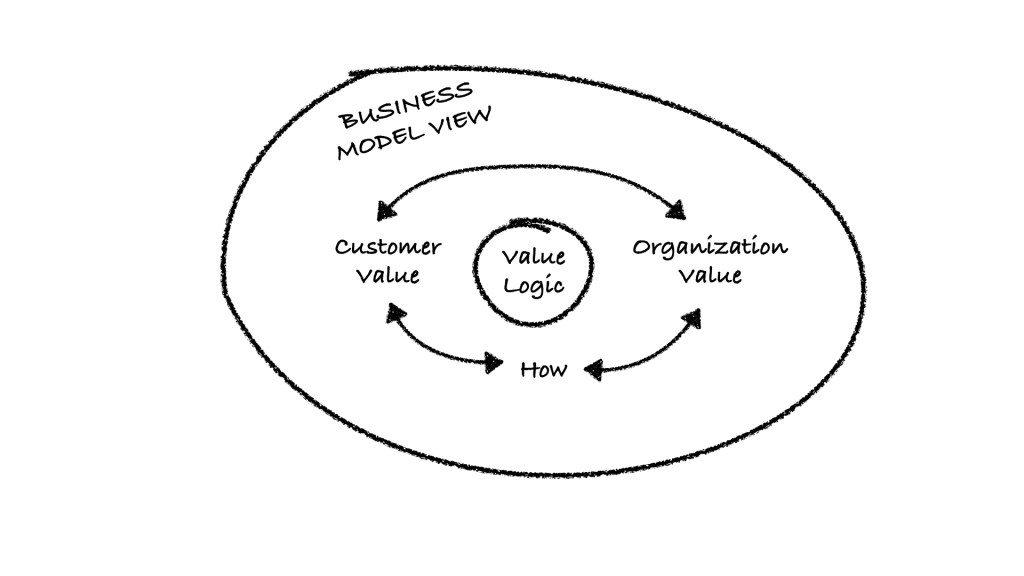
Who, What and Why Of Customer Value
Identifying the ‘Who, What and Why’ of Customer Value is the first step in understanding a firm’s Business Strategy by reverse designing it’s Business Model. While ‘Who, What and Why’ are interdependent choices and must always be considered together in practice, for the purposes of writing bite-sized Posts, I will artificially separate them for now. The remainder of this Post will focus on ‘Who’ while Part II will focus on ‘What and Why’.
Understanding and making choices about ‘Who’ starts with clarity on the organization’s external context, its Arenas. These are the industry sectors, geographies, socio-economic segments, technologies, value chain stages and product/market segments that might represent an opportunity for an organization’s products or services. Potential Customers are those segments within the specified Arenas who may, under the right circumstances, buy the product or service. Primary Customers are those Customer segments that the organization chooses to focus its value creation activities on.

Who Customers are not
How does an organization clarify who its Primary Customers are? It requires some tough choices, so let’s start with some guidelines on ‘who Customers are not’. Customers are not internal to the organization in question. Rather, people and departments/functions within a firm are partners in a ‘whole of business system’, each with different roles, but each working together to create value for external Customers.
I sometimes get pushback on this point with examples of firms that have successfully broken up a large bureaucracy into small independent cells that contract with each other in a supplier — customer relationship. I argue that this approach might work in some rare situations but only if there is a very clear, shared understanding and acceptance of ‘Who’ the external Customers are and what the Value Proposition to those Customers is.
Customers are not shareholders or other stakeholders, nor are they enablers such as donors, funding bodies or regulators. These groups figure in Business Model design, and they’re linked to Customer Value creation, but in SCIP, they’re addressed in choices about Organization Value creation.
Most importantly, Customers are not ‘average’. Firms that rely only on demographic segmentation understand their Customers in ‘average’ terms and usually default to offering a list of all the benefits of a product/service to all potential Customers. It’s a shotgun approach with low odds of success.
Who Customers are
Customers provide, or have the potential to provide revenue, either directly to organizations through transactional engagement or indirectly through enabling activities. For example, the Customers of prescription Pharma companies are the doctors who prescribe their products and enable a revenue flow to the company from a third-party payer (government, insurance company, consumer).
Customers can be end-users or beneficiaries of a product or service, intermediaries in a value chain or partners in a platform Business Model. For example, Amazon operates a digital platform that links four different Customer groups to each other — consumers, sellers, enterprises and content creators.
From Potential Customers to Primary Customers
In refining potential Customers into Primary Customers — those that really matter — there are several considerations. First, as I mentioned earlier, it is critical to realize that the ‘Who’ of Customer Value creation cannot be understood independently of the ‘What’. Both choices are inextricably linked — there must be a match between the dimensions of value that are important to a chosen Customer segment (because these are indicative of likely behaviour) and the firm’s current or potential offerings.
Second, Primary Customers may be current Customers and/or new Customers but they’re never static for long. The ‘Who’ of Customer Value will always evolve as a firm’s environment changes.
Third, the Organization Value creation potential (Economic, Social and Environmental), both short and long term, associated with the choice of Primary Customers is critical. Organization Value and Customer Value are interdependent choices. You cannot make a choice about one without reference to the other. There will always be trade-offs relative to Organization Value creation in deciding which group of Customers to focus on.
Fourth, there are the risks associated with either supplying or not supplying a certain Customer segment. This is a complex and multi-factorial area. To name a few examples, there are market factors such as exposing the firm to the buying power of a large Customer, or the threat posed by competitive players. There are also internal factors such as the nature and level of the required investment in capabilities and resources to service certain Customers. In addition, there are risks associated with sourcing, currency, technology, government, regulation and so on associated with certain Customers.
Not everyone is your Customer. Beware the Zone of Mediocrity
Finally, it’s critical to realize that not everyone is your Customer. If everyone in a given market is your Customer then you will default to offering all things to all people. You will be stuck in the Zone of Mediocrity.
There is a famous story about Herb Kelleher, the former CEO and co-founder of Southwest Airlines, and a woman who wrote a complaint every time she flew Southwest. There were so many complaints and so many attempts to appease her that someone finally bumped the most recent complaint ‘upstairs’ to Herb. He supposedly responded with a very simple letter that said:
Dear Mrs………. We will miss you. Love, Herb
The moral of the story — your odds of success will be better if you choose your Primary Customers carefully, not everyone is your Customer.
Summary: Being Customer Centric is not strategy. It’s common sense. The end goal of Business Strategy is to create Customer Value. Business Strategy begins with clear choices on the ‘Who, What and Why’ of Customer Value. These are interdependent choices that must always be considered together in practice. Choosing ‘Who’ your Primary Customers are depends on the match between their value expectations, your offering (or potential offering), the potential for Organization Value creation this match provides and your appetite for risk. And not everyone is your Customer……that’s a recipe for mediocrity.
Question: How does your organization choose its Primary Customers?

 Strategy Conversations In Practice
Leave a reply to Want Better Strategy? Start With Making Sense Strategy Conversations – Strategy Conversations In Practice Cancel reply